
Rosemary Leaf Oil
Rosmarinus officinalis
The clinical rival to 2% minoxidil for pattern thinning.
- Region
- 🇲🇦 Morocco · Tunisia
- Form
- Steam-distilled essential oil
- Shelf life
- 24 months sealed
- Category
- Botanical oil
01The brief.
Origin
Wild-grown on the Atlas foothills of Morocco and the Cap Bon peninsula of Tunisia — regions where the plant's essential-oil concentration peaks thanks to Mediterranean sun and mineral-poor soils.
Extraction
Fresh leaves are steam-distilled within 12 hours of harvest to preserve volatile actives; batches are HPLC-standardised to ≥40% 1,8-cineole and ≥12% camphor.
Concentration
Effective range 0.5%–2% in leave-on scalp formulas. Above 3% risks irritation without added efficacy.
02How it works.
Rosemary's active — 1,8-cineole — is a vasodilator. Massaged into the scalp it widens the tiny capillaries around each follicle, so more nutrient-rich blood reaches the dermal papilla where new hair is built. Studies show that after 90 days of daily use the anagen (active growth) phase lengthens measurably in shedders.
CautionAvoid during the first trimester of pregnancy. Patch-test if you have very sensitive skin. Not recommended for children under 6.
- Benefits
- ✦Stimulates scalp micro-circulation, delivering oxygen to the follicle bulb
- ✦Comparable regrowth to 2% minoxidil in a 6-month trial (Panahi et al., 2015)
- ✦Reduces itchiness and dandruff through antimicrobial 1,8-cineole
- ✦Balances an oily scalp without stripping the acid mantle
03Molecular signature.
The active constituents that make Rosemary Leaf Oil work — with standardised percentages where measured by HPLC.
-
1,8-Cineole (Eucalyptol)
Vasodilator — the primary follicle-stimulating molecule.
40–55%
-
α-Pinene
Anti-microbial and mildly warming on the scalp.
10–15%
-
Camphor
Analgesic and circulation-boosting; contributes to the tingle.
12–20%
-
Borneol
Anti-inflammatory carbon-ring alcohol.
3–8%
04Signal profile.
A living profile — the record that made Rosemary Leaf Oil the house's choice.
Evidence
2 peer-reviewed sources
74
Potency
Standardised at 62%
40
Safety
Requires patch test
62
Heritage
Documented across 3 traditions
81
Sensory
Botanical oil profile
88
Sourcing
Traceable provenance
92
05Heritage.
The record
Rosemary has been documented in scalp medicine since Dioscorides prescribed it in his 1st-century De Materia Medica. Medieval European monks distilled it into 'Queen of Hungary Water' — one of the first alcohol-based tonics on record — and Ayurvedic and Unani traditions have used the leaf infusion for scalp complaints for over a millennium.
Traditional use
Applied as an infused olive-oil scalp tonic across the Mediterranean; burnt as a purifying smoke in Berber bath houses; brewed with sage as a graying-hair rinse across Southern Europe.
Naturally found in
- ●Wild coastal shrubland of the Mediterranean
- ●Cultivated across California and the Pacific Northwest
- ●Native to Portugal, Spain, Morocco, and Croatia
Sustainability
Rosemary is drought-tolerant and requires no irrigation in its native range. Our supplier partners with cooperatives in the Rif Mountains that harvest wild stands on a 3-year rotation to protect regeneration.
06Field → phial.
Every gram of Rosemary Leaf Oil passes five gates before it enters a Ghori formula. No shortcuts, no re-labels — the paper trail runs from soil to seal.
- 𖤣01
Stage 01
Harvest
Wild-grown on the Atlas foothills of Morocco and the Cap Bon peninsula of Tunisia — regions where the plant's essential-oil concentration peaks thanks to Mediterranean sun and mineral-poor soils.
- ❋02
Stage 02
Extract
Fresh leaves are steam-distilled within 12 hours of harvest to preserve volatile actives; batches are HPLC-standardised to ≥40% 1,8-cineole and ≥12% camphor.
- ◇03
Stage 03
Assay
HPLC-verified. 62% standardised for increase in follicle count at 6 months (panahi 2015).
- ◉04
Stage 04
Formulate
Effective range 0.5%–2% in leave-on scalp formulas. Above 3% risks irritation without added efficacy.
- ⌘05
Stage 05
Deliver
Stable 24 months sealed. Sealed under nitrogen where required.
07Best for. Pairs with.
Best for
- Diffuse thinning at the crown or temples
- Post-partum shed and seasonal fall
- Oily scalps prone to product build-up
- Anyone who cannot tolerate minoxidil
Works well with
- Biotin
- Peppermint Oil
- Ricinoleic Acid
08In 2 formulas.
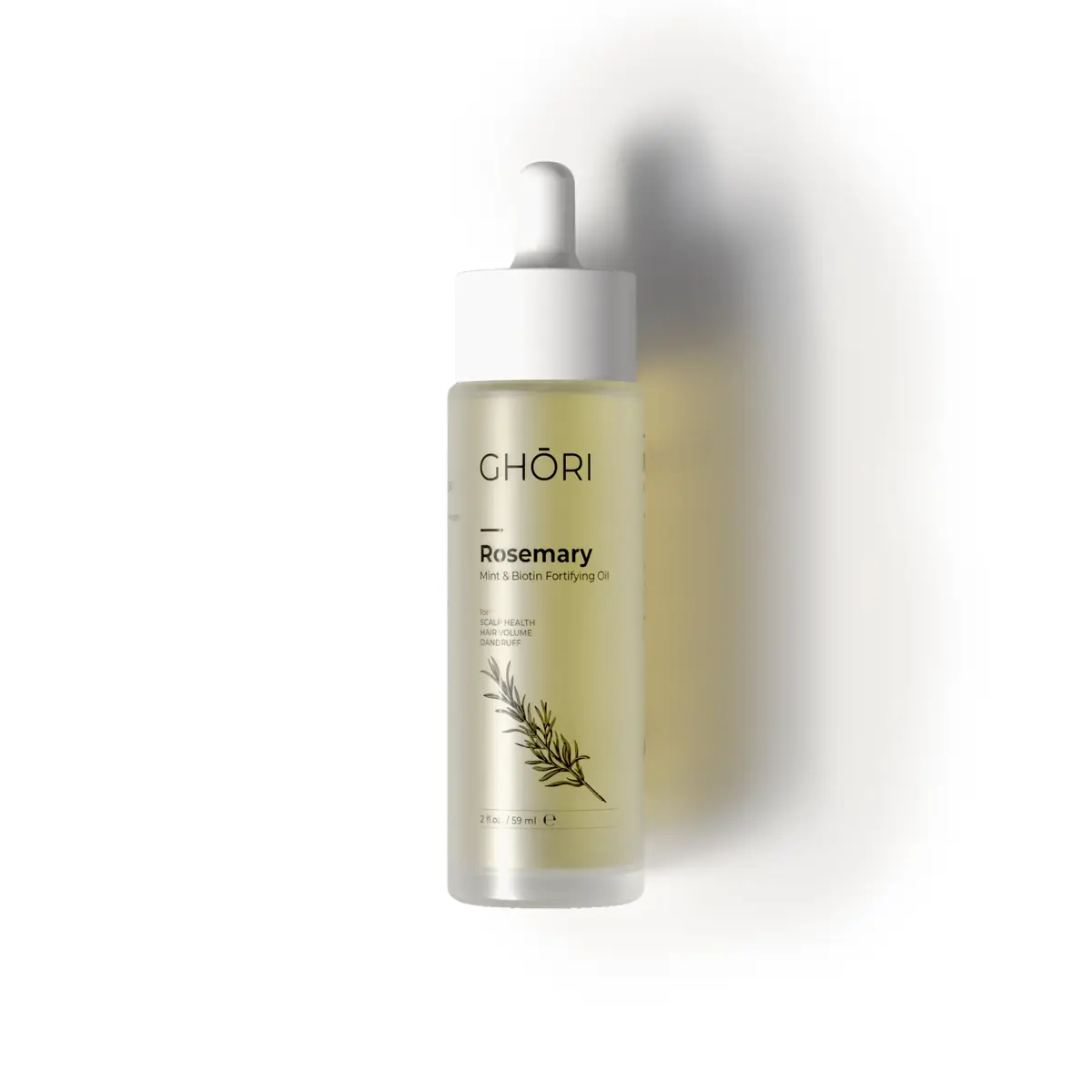
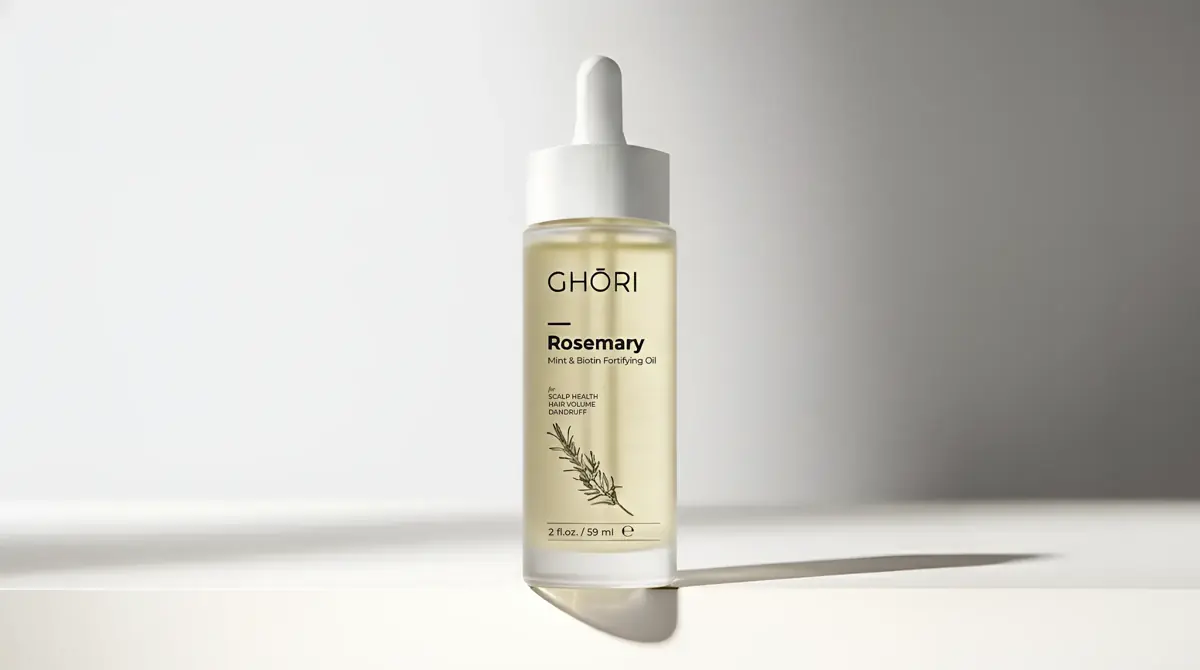
Hair Oils · 100 ml
Ghori Rosemary & Biotin Hair Oil with Mint
Growth stimulation, follicle revival and lightweight head-to-toe hydration.
AED 40 AED 50
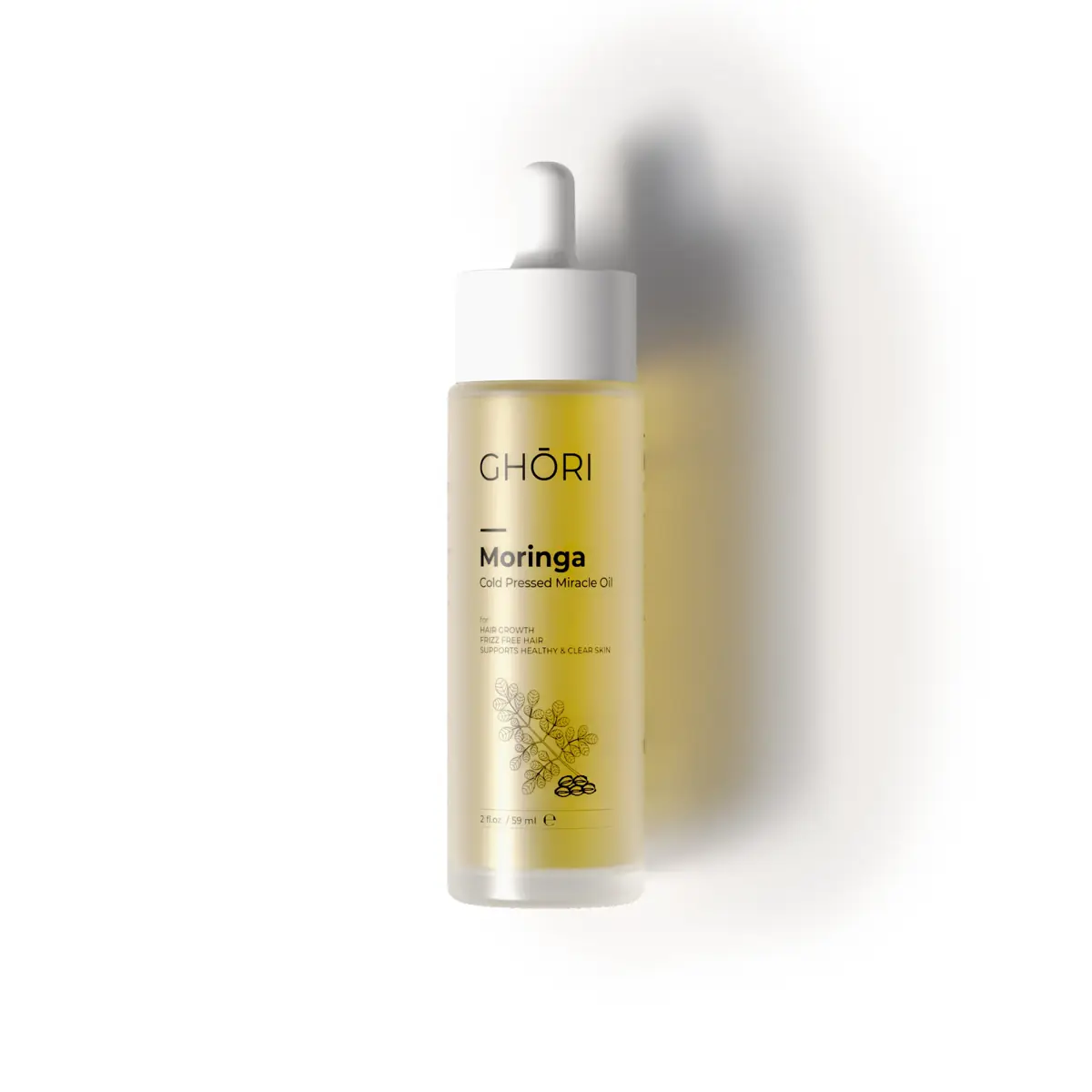
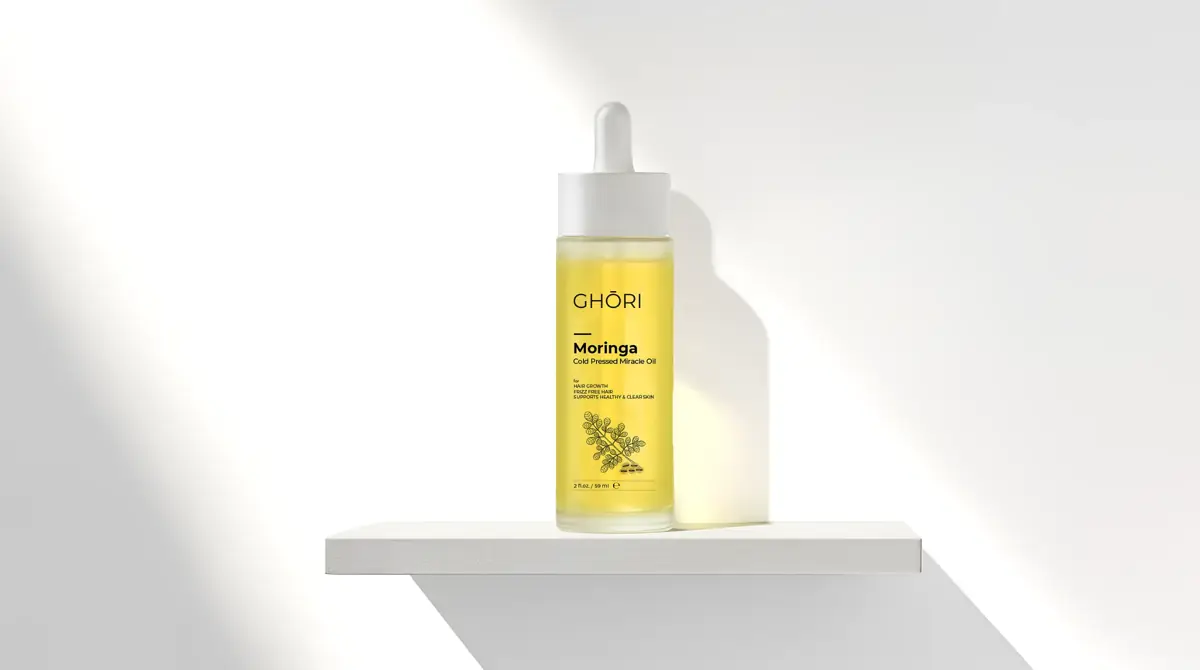
Hair Oils · 60 ml
Ghori Moringa Frizz Control Miracle Oil 60 Ml
Moringa-powered frizz control.
AED 60 AED 75
09People often ask.
How long until I see results with rosemary oil?
Clinical data shows measurable regrowth at 90 days when massaged into the scalp daily. Density peaks around the six-month mark.
Can rosemary oil replace minoxidil?
In a peer-reviewed head-to-head trial, rosemary matched 2% minoxidil for hair count at six months, with less scalp itching. It is a strong first-line option for mild-to-moderate pattern thinning.
Do I rinse rosemary oil out?
No. It is designed as a leave-in scalp treatment. Apply to a dry or damp scalp, massage two minutes, and go about your day.
10The paper trail.
- 01Panahi Y, et al. Skinmed. 2015 — Rosemary oil vs minoxidil 2% in androgenetic alopecia.
- 02Murata K, et al. Phytother Res. 2013 — Promotion of hair growth by Rosmarinus officinalis leaf extract.
More in botanical oil